


RSR & MTRG Roots Blower | Wastewater Sewage Aeration | SHANGU MingTian

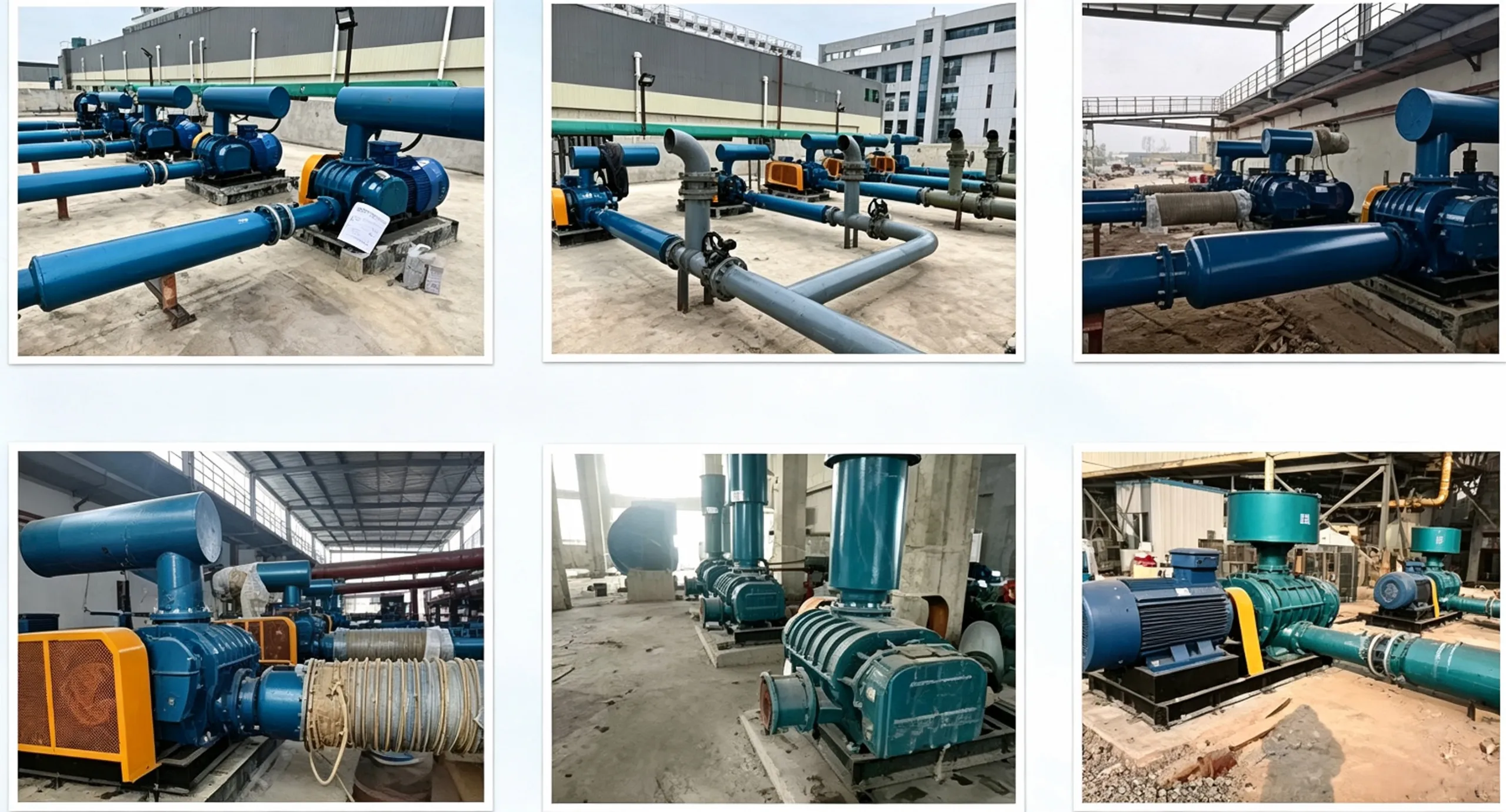
SHANGU® RSR / MTRG Series Roots Blowers for Wastewater Aeration & Wastewater Treatment
Product Overview
For municipal sewage, industrial wastewater and decentralized rural wastewater projects, aeration roots blowers serve as core oxygen‑supply equipment for biochemical treatment. They deliver compressed air for aerobic‑tank microorganism organic‑matter degradation, sludge agitation, pre‑aeration, dissolved‑air flotation and denitrification processes.
SHANGU® RSR & MTRG tri‑lobe roots blowers are engineered by Shandong Mingtian Machinery Group for medium‑low‑pressure, 24/7 heavy‑duty and high‑humidity wastewater conditions. As positive‑displacement blowers, they maintain stable volumetric airflow even under diffuser clogging and water‑level fluctuation.
Widely applied in municipal sewage, chemical‑plant effluent, aquaculture wastewater, printing‑dyeing wastewater and decentralized rural sewage stations. Material options include standard HT250 cast‑iron housing & rotors, heavy‑duty epoxy coating, optional 304 / 316 L stainless‑steel rotors and casings for corrosive industrial effluent.
Rare Practical Field Tips (Seldom Published Online)
- All catalogue nominal data are based on standard suction condition (20 °C, 101.3 kPa, RH 65 %). At high‑altitude or high‑ambient‑temperature sites, air density drops and mass oxygen‑supply capacity decreases. Condition correction is mandatory; add an 8‑12 % flow margin for every 1000 m elevation rise. Never directly adopt catalogue parameters without site‑specific correction.
- For wastewater‑treatment selection: working pressure is NOT equal to tank water depth. Total pressure drop shall include pipe friction loss, elbow loss and aeration‑diffuser resistance. Many projects suffer insufficient oxygen supply and non‑compliant effluent COD because pressure is calculated only by water depth.
- Wastewater‑treatment intake air carries large amounts of water vapour. Ordinary rubber seals age rapidly. Even for ordinary sewage service, upgraded moisture‑resistant seals are recommended to avoid oil leakage and gradual flow decay within 8‑12 months.
- Avoid excessive safety margin: if flow‑pressure margin exceeds 30 %, blowers operate under long‑term low‑load status, resulting in 20 %+ extra power consumption. Reasonable engineering margin is 10‑15 %.
- Multi‑layer anti‑backflow protection is required for shutdown risk. A swing check‑valve alone is insufficient; a bypass vent pipeline shall be equipped to prevent wastewater backflow into blower casing.
Applicable Industry Standards
- JB/T 8941.1‑2014: Roots type blowers for general purpose — Part 1: Specification
- JB/T 8941.2‑2014: Roots type blowers for general purpose — Part 2: Performance test method
- HJ/T 251‑2006: Environmental‑protection product technical requirement for roots blowers (for water‑treatment & flue‑gas treatment)
- GB/T 2888‑2008: Method of noise measurement for fans and roots blowers
- GB 28381‑2026: Minimum allowable values of energy‑efficiency and energy‑efficiency grades for blowers
Standard Equivalence Note
JB/T 8941.1‑2014 is MOD (Modified Adoption) of ISO 1217:2009 Displacement compressors — Acceptance tests, NOT identical adoption. Third‑party ISO 1217 lab reports serve only as reference. Domestic Chinese wastewater‑treatment projects shall perform final acceptance according to JB/T and HJ/T standards. Differences exist in 24‑hour heavy‑duty test criteria, allowable internal‑leakage deviation and accessory‑assessment clauses. Pay attention for overseas retrofit projects.
Unit‑Conversion Guide (For Tender & Cross‑border Comparison)
Pressure:
9.8 kPa = 0.1 kgf/cm² = 1000 mmH₂O = 1.422 psi
Flow:
1 m³/min = 60 m³/h = 35.71 CFM
Gas‑state conversion:
Standard suction‑state flow Qₛ (20 ℃) = Qₙ (0 ℃) × 1.0732
Important remark: Catalogue performance is measured under 20 ℃ standard suction condition. Flow correction shall be applied for high‑altitude & high‑temperature sites. Clearly mark gas‑state definition in inquiry documents to avoid parameter misunderstanding.
Key Buyer Concerns (Explicit Requirements & Hidden Field Pain‑points)
✅ Explicit Requirements
- Flow & pressure matching tank depth, total resistance of piping + aeration diffuser, to satisfy biochemical oxygen demand;
- Noise & vibration comply with plant‑site boundary environmental regulations;
- Initial‑investment budget and motor‑power requirements;
- Support VFD linkage with DO (dissolved‑oxygen) transmitter.
✅ Hidden Pain‑points (Production‑loss risk often outweighs equipment price gap)
- Seal‑ageing risk under humid atmosphere: Wastewater plants operate under high‑humidity ambient conditions. Ordinary seals degrade quickly by water‑vapour exposure, leading to oil leakage and flow decay, further causing insufficient oxygen supply and non‑compliant effluent.
- 24‑7 continuous‑run reliability: Municipal sewage plants run non‑stop all year round. Units ≥ 60 kPa(gauge) shall adopt water‑cooling construction to avoid oil overheating, oil emulsification and unplanned shutdown that triggers wastewater‑discharge violation.
- Resistance‑fluctuation adaptability: Aeration diffusers clog gradually and raise system back‑pressure. Positive‑displacement blowers shall keep stable effective airflow for consistent microorganism oxygen supply.
- Total‑lifecycle energy cost: Aeration blowers consume 40‑60 % of total power consumption of a wastewater plant. Evaluate long‑term electricity cost and spare‑part expense instead of focusing merely on purchase price. Improper margin setting causes huge extra power‑cost loss.
- Anti‑backflow protection & after‑sales response: Wastewater backflow causes severe equipment damage. Sudden blower failure will lead to effluent non‑compliance within short time. Manufacturers shall provide condition calculation, fast spare‑part delivery and on‑site technical support.
Core Product Advantages | SHANGU® by Shandong Mingtian Machinery Group
Shandong Mingtian Machinery Group is a national Hi‑Tech Enterprise and national‑level Specialized‑Sophisticated “Little‑Giant”. Two industrial parks are equipped with 5‑axis machining centers, high‑speed dynamic‑balancing testers and three‑coordinate measuring instruments. The R&D team includes professor‑level senior engineers, PhD and master specialists with university‑industry‑research cooperation. SHANGU® is a well‑known trademark of Shandong Province.
- Constant‑volume anti‑back‑pressure performance: Tri‑lobe rotors pass G2.5‑grade high‑speed dynamic balancing. Stable airflow output even under diffuser clogging and water‑level variation, guaranteeing stable dissolved‑oxygen level for biochemical tanks.
- Customized material solution for high‑humidity wastewater service: Moisture‑resistant seals as standard option; heavy‑duty epoxy coating or 304 / 316 L stainless‑steel rotor & housing for corrosive industrial effluent; explosion‑proof packages available for wastewater containing volatile organic vapour.
- Water‑cooling for high‑pressure duty: Units ≥ 60 kPa(gauge) equipped with circulating water‑cooling system for non‑stop 7 × 24‑h full‑load operation.
- Full‑scope package supply: Inlet filter, inlet‑outlet silencers, safety relief valve, swing check‑valve, vent‑valve assembly, anti‑vibration base, flexible expansion joints. Optional VFD cabinet to link with DO dissolved‑oxygen transmitter, delivering 18‑30 % energy‑saving.
- Full‑scope factory acceptance test: Every blower passes performance, noise & vibration tests complying with JB/T 8941, HJ/T 251‑2006 and GB/T 2888. Complete test‑report documentation for tender and project acceptance.
- Full‑process technical service: Site‑condition survey, comprehensive calculation considering altitude‑temperature‑pipe‑resistance; installation briefing; retrofitting for old aeration blowers; regular‑maintenance guidance.
Application Scenario & Model‑Selection Reference
Selection tips: Reserve 10‑15 % margin for flow‑pressure parameters. Select MTRG water‑cooled series for pressure>88.2 kPa. Upgrade anti‑corrosion / explosion‑proof for corrosive industrial wastewater. 1 operating + 1 standby configuration recommended for critical wastewater plants. Perform condition correction for high‑altitude & high‑inlet‑temperature sites.
| Application Scenario | Working‑condition Description | Recommended Model | Flow (m³/min) | Gauge Pressure (kPa) | Motor Power (kW) | Remarks |
|---|---|---|---|---|---|---|
| Decentralized rural sewage / small‑size industrial wastewater station (50‑500 m³/day) | Tank depth 4‑5 m, small‑medium airflow, intermittent or continuous operation | RSR100 | 5‑18 | 39.2‑58.8 | 7.5‑30 | Standard moisture‑resistant sealing; VFD optional for DO‑transmitter linkage |
| Medium‑small municipal sewage plant / printing‑dyeing & aquaculture wastewater | Capacity 500‑5000 m³/day, tank depth 5‑6 m, 7×24‑h continuous aeration | RSR150A | 18‑35 | 49‑78.4 | 30‑75 | Water‑cooling recommended for pressure>60 kPa; upgrade sealing & coating for chemical effluent |
| Medium‑size municipal sewage plant / comprehensive chemical wastewater | Large tank volume, depth 6‑7 m, long pipeline, non‑stop 24‑h operation | MTRG250 | 35‑60 | 68.6‑98 | 75‑132 | Mandatory water‑cooling; stainless‑steel rotor optional for corrosive media; 1‑op‑1‑standby recommended |
| Large‑scale municipal sewage plant / high‑salt chemical wastewater treatment | Large throughput, deep tank, high pipeline resistance, year‑round continuous‑run | MTRG300 | 60‑105 | 78.4‑117.6 | 90‑160 | Heavy‑duty water‑cooled package; total pipe & diffuser resistance calculation required before order |
| Auxiliary flotation, sludge fluidization, pre‑aeration for wastewater system | Large‑flow low‑pressure duty for dissolved‑air flotation, sludge mixing | RSR175A~RSR200 | 15‑48 | 29.4‑49 | 22‑90 | Optimized for large‑flow low‑pressure air supply |
Model Explanation
- RSR Series: General‑purpose tri‑lobe roots blowers (belt / coupling drive), for medium‑low‑pressure wastewater aeration;
- MTRG Series: Mingtian heavy‑duty water‑cooled roots blowers, built for deep‑tank, long‑pipeline and heavy‑duty non‑stop service, with built‑in cooling‑water ports.
Installation & Maintenance Guidelines
- Never subject pipeline weight onto blower flanges. Install flexible expansion joints both at inlet and outlet to eliminate pipe stress and isolate vibration transmission.
- For wastewater‑aeration service: equip swing check‑valve + bypass vent‑valve on discharge pipeline; set blower mounting elevation higher than maximum tank liquid‑level as much as practical for multi‑layer anti‑backflow protection.
- Install filter elements inside cooling‑water circuit for regular descaling for water‑cooled blowers.
- Perform shift‑based inspection for pressure, running current, bearing temperature and seal water‑vapour leakage. Shorten service interval for inlet‑filter and sealing components under high‑humidity environment.
- Inspect rotor corrosion and seal ageing during annual shutdown maintenance; proactively replace wearing parts to avoid unplanned shutdown and effluent non‑compliance risk.
Disclaimer: All tabulated parameters serve for general‑reference only. For real‑world projects, please provide daily‑treatment capacity, aeration‑tank depth, total pipe‑length, elbow quantity, medium corrosivity, site altitude and inlet‑air temperature. Our technical engineers will deliver condition‑corrected custom proposal.
Inquiry — Please provide below information for customized solution & formal quotation
Kindly send your project parameters, our engineering team will prepare tailor‑made blower solution and formal commercial quotation:
- Wastewater daily treatment capacity;
- Aeration tank depth, total pipe length, elbow quantity, diffuser type;
- Wastewater property: ordinary municipal sewage / chemical / high‑salt / corrosive effluent;
- Required working flow(m³/min or CFM), working gauge pressure(kPa or psi);
- Operation mode: 24‑h continuous / intermittent operation;
- Special requirement: VFD / explosion‑proof / anti‑corrosion / standby‑unit requirement;
- Power‑supply standard (voltage & frequency);
- Site‑ambient condition: altitude, average ambient temperature;
- Any other site‑specific technical or safety requirements.
Contact Us
- 📞 Phone / WhatsApp: +8618753163090
- 📧 Email: [email protected] | [email protected]
- 🌐 Official Website: www.mtrootsblower.com
- 📞 WhatsApp / Wechat: +86 187 5316 3090
- 📧 Email: [email protected]